
One perpetual debate among home brewers is the relative advantages of glass vs plastic fermenting vessels for making beer. Most beginner home brew kits come with a large plastic pail with a plastic top. However many advanced brewers swear by the advantages of the classic 5 gallon glass carboy. So who is right? This week we take a look at them side by side.
The Plastic Fermentation Vessel (aka Bucket)
 Most brewers start fermenting in a 5 gallon food grade plastic bucket. These buckets are cheap, durable and relatively easy to clean. However the plastic bucket has both advantages and disadvantages:
- The plastic bucket is easy to clean – since the entire top comes off, you can reach in and scrub any grime off in a few minutes
- Plastic is durable – if you do drop the bucket it is unlikely it will break, and they do last a long time
- Plastic is harder to sanitize completely – over time it does get small scratches on the inside which can be a haven for bacteria and germs, which is why most brewers recommend replacing plastic buckets after a year or two
- Plastic is not suitable for long term storage of beer (i.e. months), as it is permeable to air
- Many plastic buckets have a poor seal between the bucket and cover – which can result in air being introduced as well as the brewer thinking fermentation is done prematurely (as the airlock has stopped bubbling due to the leaks)
The Glass Carboy
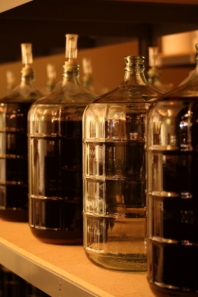
In the other corner, we have the 5 gallon glass carboy. A carboy is a large water bottle made of real glass, and usually comes in either a 5 gallon or 6.5 gallon size. Glass carboys are obviously far less durable, but are the favorite of many advanced brewers. Some advantages/disadvantages include:
- Impermeable to Air – Air cannot penetrate the glass, so you can leave your fermented beer in a glass carboy for months without worrying about it being spoiled by aeration. Also you don’t have to worry about leaks through the top as a proper stopper will form an air-tight seal.
- Easy to Sanitize – Glass will not pit or scratch like plastic, so you don’t have to worry about scratches creating havens for bacteria. Further, as the glass is transparent it is pretty easy to see if it is completely clean.
- You can Watch Your Brew – While not a huge deal, many brewers like being able to see the beer as it is fermenting to get an idea of the size of the Krausen layer, how active the fermentation is and how much sediment has formed.
- Harder to Clean – After fermentation is complete and you have transferred or bottled your beer, it can be harder to clean a glass carboy than a plastic bucket. You need a large bottle brush to do it properly and even then you may find some areas are more difficult to reach with the brush than others.
- Easy to Break – I’ve broken at least three carboys inadvertently, though thankfully I have not yet broken a full one. However, carboys are difficult to lift and maneuver, and will shatter if you bump them against any solid surface. Breaking a full carboy can be a safety hazard as well as a huge mess. I try to arrange my brewing setup so I move my carboys as little as possible once they are full.
- More Expensive – Carboys are more expensive than plastic fermentation buckets, and you also need to consider that you may break a few during your brewing career.
The Bottom Line
So which is best? I personally use glass carboys for both stages of my fermentation, and have for the last 15+ years. Why? I had some bad experiences early on when I thought my fermentation was complete, but instead found I merely had a leaky seal on my plastic bucket. In addition, I like the security of seeing my beer ferment, knowing the fermenter is completely clean and sanitized and knowing I can leave the beer in the secondary as long as I want (sometimes I get busy) while still maintaining a seal. However, the choice, as always, is yours!
Subscribe to our newsletter for a lot of great brewing articles (it costs nothing), and leave a comment below if you have your own thoughts on this subject. Thanks for joining us again on the BeerSmith Home Brewing Blog.


















What about better bottles? I get worried about breaking my glass carboys after having read a few horror stories about them. I currently ferment in 6.5 gallon carboys and love them, but I’m always nervous about them breaking. I have been thinking of moving to better bottles… would have liked to hear your take on them.
What about the Better Bottle? The plastic carboy takes most things you have in the glass carboy; then it removes the ability for it to easily break and adds the con of the scratching. They are so easy to move as they are tons lighter but they can flex in and out creating a suction. That suction can suck in whatever is in the airlock so I find it best to attach it once it’s in place.
I would like to hear a more detailed comparison between glass and plastic (better bottle) carboys.
All,
Yes I should have mentioned the “better bottle” plastic carboys. These are a nice compromise as they are not as heavy or breakable as glass, but have a carboy shape and neck so you don’t need to worry about a bad seal.
They are made from a low permeability food grade plastic, so the risk of oxidization is low. My only long term concern would be that you will need a large bottle brush to clean them which may result in some minor scratching over time – so eventually you may need to replace them.
This is not a major negative, however, as the glass ones tend to break if you use them long enough – so its probably a wash overall.
Overall – I think they are a nice compromise between the plastic bucket and glass carboy.
I use all 3, but generally prefer glass carboys.
The BBs are great outside of being more difficult to clean. As cearum mentioned, once they are full you need to remove the airlock and cover the mouth (I use sanitized foil) to prevent that ‘flex suck’ when moving them.
They tell you to not use a brush on the better bottles. They have a hydrophobic coating that allows them to easily shed most crud on them with a good soak. I find that if I clean it relatively quick it doesn’t become a problem (Especially with a good sprayer).
Justin – thanks for clarifying on the brush issue. I confess, I don’t actually own a “better bottle”, so I was going off my experience with glass bottles. As you can see, there are a number of better bottle fans here though. — Brad
A brush with Better Bottles? Huh?
That’s a *big* no-no.
All you need to do is soak it overnight with Oxyclean Free, and it’s completely clean. You never *touch* the inside much less brush it.
Then during brewday, just fill it with StarSan, let it sit while you’re mashing and boiling — and bingo — it’s ready to go.
Completely low-impact, very hands-off, and — most important — safe!
BTW — when I say “fill it StarSan” I mean fill it with your StarSan solution — 1oz. in 5 gallons — give it a big shake to get the foam going — and you’re set.
I put a wash cloth in my Better Bottle and swirl away. Just enough scrubbing action to make cleaning an easy job.
I am also a big fan of the better bottle. I agree totally with the previous poster that said soak overnight with oxyclean. I have never had to scrub them.
While I wished they had a 6.5 to 7 gallon version of the better bottle I have been able to squeeze 5.5 gallons with a good blowoff tube in the 6 gallon version.
Nice comparison. I currently use a plastic fermenter for my primary, and a glass carboy for the secondary. I find the ease of cleaning for the plastic is really nice for that first really active week of fermentation, but then the impermeability of the glass carboy is nice for really aging the beer, and the secondary usually doesn’t get too gunky.
Glass carboys would be perfect if it weren’t for the extreme danger that comes along with them.
I’ll never forget the site of my 6.5 gallon glass carboy shattering on the carpet. Followed quickly by blood gushing from my feet.
Other than that, they’re great.
I don’t have much experience with better bottles… I use a plastic fermenter and have a glass carboy for my secondary.
The plastic fermenter needs to be washed immediately after each use. I use household bleach and that gets rid of all odors and ready for the next batch…
I don’t move my glass carboy too far, but it is a little dangerous to carry 5 gallons of brew in a glass carboy…
I have been using plastic as a primary for years with no problems. Oxi-clean works great for cleaning them.
Secondary, I use the glass.
I use both in my brewing and actually start with the plastic bucket before moving on to the glass carboy for secondary fermentation. Reason being, I think it is much easier to move the wort into the plastic bucket versus using the siphon and putting it into the glass carboy. I think you are just asking to move too much sediment into the glass carboy if you are not careful.
I have used both for many of the reasons stated above. I wanted to add that about three years ago, I received two Cornelius kegs set up for secondary fermentation. While I have only thought of ways to use them for primary fermentation, they work great as a secondary.
I imagine trub and other excesses of primary fermentation would cause problems, I have been considering ways to use an old SS keg (that had the top cut off) as a primary or secondary. An acrylic lid could probably be fabricated to allow visualization as well as a seal with the proper gasket.
Regardless, lets not forget SS for use in primary or secondary fermentation.
I used to use glass, until I turned into one of those horror stories you read about.
Now I use my 5 gal corny kegs as both primary and secondary. Using CO2 rather than having to siphon is a big plus, and you don’t have to worry about sunlight or oxidation.
Along the lines of this subject, it would be interesting to hear if there is any evidence or anything on the likes of what drinking out of plastic or glass has to do with the taste and flavor of the beer.
I would assume not much though, but if you’re a slower drinker that wants to make the beer linger and last through the night…perhaps there might be….
No worrys, Ive had the same glass carboys for 20 + years take care of your equipment and it will take care of your brewing needs.as long as you don’t do any thing daft like drop them or fill hot wort with cool wort, because ” i.e. thermal shock will come about.”.glass is best.Cheers and many good pints.
hey i was wondering if you could use a jeryy can (gas can) they seem to be air tight and durable
Yes you could use a gas can if it is clean and has not been used for gas before! I would personally prefer something made out of food grade plastic, however, as it is less likely to leak air into the beer.
I have always used glass. Plastic will give off flavors that are not the best to have in your beer! Glass costs more but lasts longer and tastes so much better then plastic!
I use a glass carboy for primary, then into a bucket to add priming sugar, and into plastic bottles for secondary… I’ve seen many ways of going through the motions, but this works for me, and it works well…
Pingback: Brewing Safety
A major benefit of storing and drinking beer from glass bottle is that glass does not absorb any chemicals due to the its non-reactive nature, and secondly it helps in maintain the taste and richness of beer for longer period of time.
Pingback: A Step-by-Step Guide to Picking the Right Wine Fermentation Container