
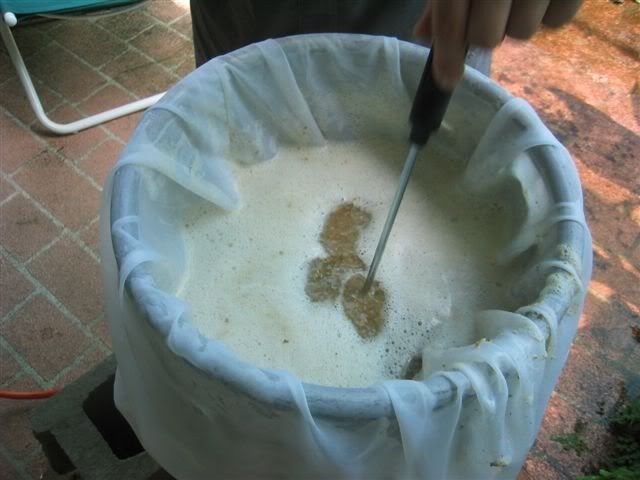
Brew in a Bag (BIAB) all grain beer brewing is a new method for all grain brewing that originated in Australia. BIAB is an inexpensive way to for homebrewers to transition to all grain or partial mash brewing. Brewers also enjoy brew in a bag methods for the shorter setup, brewing and cleanup times.
The concept behind “brew in a bag” is to move to all grain brewing with minimal extra equipment, setup or time. The BIAB method involves using a grain bag set in the brew pot to mash the grains, followed by a sparge step where the bag is removed from the pot and the remaining wort is boiled as you would any other beer. While less efficient than traditional methods, you can easily compensate for this by using a little more grain in the mash. (Ref and Image Credit: BN Article on BIAB by Thirsty Boy)
Brew in a Bag Equipment
For an all grain batch, you need a full size (batch size plus a few gallons) boil pot and ideally a propane burner to quickly boil it. For partial mash brewers, a smaller pot (3-4 gallons) is acceptable as you will not be mashing or boiling the full size of your batch. The brew in a bag method eliminates the need for a mash tun, hot liquor pot, or lauter tun.
The only other equipment needed (aside from normal extract brewing equipment) is a large grain bag. The bag should be made of a mesh material and sewn together like a great pillowcase. It should be large enough to cover the entire inside of the boil pot, and have a drawstring or tie at the top to allow the bag to be closed.
The bag will line the boil pot and closed to hold the grains during the mash. At the end of the mash the bag is slowly withdrawn and the remaining wort is boiled, cooled and fermented as any beer would be.
The Brew in a Bag Method
Brew in a bag is usually done using a single step infusion mash, the same profile most all grain brewers use. This involves preheating the water in the mash tun to a predetermined temperature before adding the grains. In a major departure from traditional methods, the entire pre-boil volume of water is used for the mash.
In BeerSmith, you can do this by choosing a single infusion, no mash out mash profile and then setting the first mash step volume (choose details next to the mash profile, then double click on the first step) equal to your boil volume.
You can also use the infusion tool to calculate initial strike additions, setting the strike volume equal to the initial boil volume for your batch. For a partial mash BIAB, less water is typically used – but again it is equal to your starting boil volume.
Once the strike water is heated to the appropriate starting temperature, the bag is added to line the edge of the boil pot, and the grains are added. Done appropriately, you should come very close to your target temperature for mash conversion – usually between 148 and 156 F.
Once you reach your target mash temperature, it is best to cover your pot and maintain the temperature as steady as possible for the next 30-60 minutes while the complex sugars in the grain are converted to simple ones. You can also wrap the pot in towels to help maintain temperature.
After the mash is complete you have the option of heating the mash slightly to a mash out temperature (around 168F). If you are planning to heat the pot while the bag is still in it, you do need some kind of screen or false bottom at the bottom to prevent the bag from getting burned or melted by direct heat from the burner. For BIAB, the mash out aids overall extraction efficiency when you remove the bag.
Finally, slowly lift the grain bag out of the pot and let it drain. Once the bag has drained you can empty it, spray it down and clean it off for reuse on your next batch of beer.
From this point forward, the wort left in your boil pot can be boiled, cooled and fermented just as you would any batch of beer. If brewing all grain, simply boil the wort with hop additions, cool it and transfer to your fermenter. For partial mash, you can add your extract, hops and continue to brew.
Advantages and Disadvantages
Some of the advantages of the brew in a bag method include:
- Equipment Cost – If you have a large brew pot already, the only additional equipment needed is a bag, which you can make yourself if you have access to a sewing machine.
- Simplicity – Brew in a bag lets you move to all grain or partial mash brewing in a simple way, and the method itself is very simple to set up and execute, even with limited space.
The limitations include:
- Batch Size – All of the grains have to fit in the bag, and the bag has to be lifted out without breaking, so this does place some limitations on high gravity batches. However with a properly stitched grain bag, double batches are possible though a pulley may be desirable.
- Efficiency – Since BIAB is a full volume method, you will lose a few percent efficiency – overall batch efficiency is usually lower than with fly sparge methods. However, this can easily be compensated by adding a little more grain to the batch and formulating your recipes with the appropriate lower brewhouse efficiency estimate. Experienced BIAB brewers have reported efficiency as high as 80% in some cases.
- High Water to Grain Ratio – Mashing at a high water to grain ratio, as is the case here, results in lower levels of beta-amalyse, resulting in more dextrines in the finished beer. This can translate to higher body than desired at the high end of the mash temperature range (156-158F). Conversely, the thin mash also works poorly at the low end (148-150F), creating dry beer. In general BIAB works best in the mid mash temperature range (150-156F). Finally, if you are brewing a beer high in non-barley adjuncts such as flaked wheat, BIAB may not be the best option. (Ref: BN Article on BIAB)
I hope you enjoyed this week’s article on brew-in-a- bag. Thanks again for visiting us on the BeerSmith home brewing blog. Don’t hesitate to subscribe for regular delivery, and have a great brewing week.


















Pingback: Small Batch BIAB Kettle | McPhillips Brewing
Pingback: What is the minimum amount of equipment to dabble in All-Grain? | CL-UAT
Pingback: Sub $20 brewery | rampant slug
I do believe all the concepts you have offered
in your post. They are really convincing and will certainly work.
Still, the posts are too quick for beginners. May you please prolong them a little from next time?
Thanks for the post.
Pingback: Mash Temperature Adjustment for Home Brewing | Home Brewing Beer Blog by BeerSmith
Pingback: Brew-in-a-Bag All-Grain Homebrewing – The Equipment – MacBourne's Musings
I use nylon 5 gallon paint strainer bags. These are available at your local “big box” home improvement stores.
According to beer experts in order make a beer tasty depends on how the brewing process of the beer.
Pingback: → Curso Produção Cerveja Artesanal Bia Bier Vale a Pena? - Curso Produção Cerveja Artesanal Bia Bier