
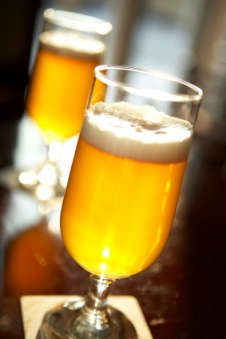
You want a good lager, but you can’t make one because you do not have refrigeration? Try a making a Kölschbier! Today, guest blogger DJ provides an excellent summary of how to brew Kölsch.
History
Kölsch (pronounced “koelsch”) is a beer brewed exclusively by the breweries in Köln (or Cologne to the English speaking countries). The beer style has been around for several centuries, but was never called Kölsch until the Sünner brewery labeled it as such in 1918. In the 1930s, at least 40 breweries made Kölsch. Unfortunately the World War decimated the German Kölsch industry and only 2 breweries remained.
Since the European Union gave special protection to Kölsch in 1997 (geschützte Herkunftsbezeichnung), only 14 breweries legally produce Kölsch. This restriction is an extension of the Kölsch Convention of 1986. The Kölsch Convention states that Kölsch must be brewed in Köln, pale in color, top-fermented (ale), hop accentuated, and filtered. In short, the beer is a pale ale from Köln.
The culture of this beer is also unique. People from all economic classes enjoy the beer. Karl Marx remarked that his revolution could never take hold in Köln, because the workers drink with their bosses. The beer is so anti-class that the breweries all agreed that no Kölsch would be sold with “special”, “extra” or any other add-on.
But it tastes like a lager!
Kölsch is ale that tastes like a lager. If you handed a Kölsch to an unaware beer drinker, it is very common to mistake the beer as a lager. The beer has a very soft mouthfeel. It can be slightly sweet, but has no malty aroma and finishes very dry. Some Kölschbiers have some fruity flavor, but it is very slight. Any fruitiness in the beer should be very subtle.
There is no hop aroma and little hop flavor. It is very low in esters, and has no diacetyl. These beers typically are between 4% to 4.5% ABV. The Brewer Style guidelines list the beer’s alcohol content at 4.4 – 5.2% ABV, but I would error on the lower end of the spectrum. The color of the beer is straw-like (3.5-7 SRM). Kölsch is similar to an American Blonde Ale, but finishes much cleaner and crisper.
Some commercial examples of the beer are Reissdorf, Gaffel, Alaska Summer Ale, Harpoon Summer Beer, or Sünner Kölsch. The American versions are “Kölsch-style” since they cannot be called “Kölsch”.
The Recipe
Like any German beer, the ingredients for this beer follow Reinheitsgebot. Kölsch typically uses German pilsner malt and/or pale malt. Some recipes use wheat malt or Vienna malt, but it is less common. Wheat malt is not common in the commercial versions of the beer, but shows up in many homebrew recipes. Most Kölsch recipes use Spalt hops, but other German noble hops can be used. The beer uses very soft water and is often lagered for a month after fermentation. Here’s the recipe I use.
- 10 lbs German Pilsner Malt
- 0.5 lbs German Munich Malt
- 1.5 oz Spalt hops (4% AA bittering for 60 minutes)
- White Labs WLP029 German Ale/ Kölsch or Wyeast 2565 Kölsch
If you are an extract brewer, use 8 lbs of Pilsner LME and 0.25 lbs of Munich LME. Sometimes Spalt hops are difficult to find (especially with the hop shortage). You can substitute the Spalt hops with Saaz, Hallertau, or Tettnanger. Mt. Hood can also be used. The hop you select is strictly for bittering, because Kölsch should have little to no hop flavor and no hop aroma.
Mash the grain for 90 minutes at 150°F (65°C). This should give you a good fermentable wort. Boil the wort for 90 minutes. At the 60 minute mark, add your hops.
Ferment the beer at 60°F (15°C) or as close as you can get to 60°F (15°C). Once the fermentation is complete, find a cold place to store the beer for a few weeks. A lagering period will help the beer if you can do it, but don’t sweat it if you can’t.
At bottling, add 1 ¼ cup of light DME that is boiled in 2 cups of water for 10 minutes. If you are kegging, carbonate the beer to 2.5 volumes.
This beer is great for those hot summer days. I’ve even heard it referred to as the “lawnmower ale”. The traditional serving glass for Kölsch is a cylindrical 200 ml glass called a stange (pole). The serving temperature should be cellar temperatures (50°F/10°C).
Editors Note: Today’s article was guest authored by DJ Spiess of The Fermentarium – thanks again to DJ for providing this great piece on Kolsch. If you enjoyed this article, please leave a comment or subscribe for more great articles. Use the BrewPoll button on the right to vote for this article!


















Mike G I am wondering the same thing. I brewed on Sun 5-6 with an OG of 1.048 and today 5-12 the gravity is at 1.006 @ 67 deg. I still have a big bubble evry 11 seconds in the airlock. I’m wondering if I go too low with the FG if it will be too “thin” or too dry. Do I stop fermentation by cold crashing in primary or rack to secondary and cold crash? thanks for any help.
Evenin’, is this a 5 gallon boil ?? thanks, Jim
Another article poorly researched. Kolsch is NOT , repeat NOT an ale.Germans do not call their beers ales.And never have done. That appelation has been thrust on them by poorly informed American homebrewers who think that ale is simply a top fermented beer.Ale is one family of brewing and Kolsch comes from another. Legally it’s defined as “obergäriges lagerbier”
It does NOT obey the Reinheitsgebot , it was specifically invented to bypass it.The Reinheitsgebot only applies to bottom fermented beer and when this law was extended to the whole of Germany in the early 1900s the brewers in Koln were forbiddeen to use some of the ingredients they had traditionally used.They overcame this by switching their yeast to a top fermenting variety-a Kolsch yeast NOT an ale yeast by the way- but cool fermenting and-here’s the clue-lagering it.It isn’t an ancient brew at all, but as Kolsch simply means “From Koln” the name will of course have been used to describe any of the local products.
A plea to beer wtiters-do not simply “cut and paste” what you find.Look for articles which provide contemporary references and sources.Check that what you say is based on facts and not on what somebody else ays or writes.
My husband is the brewer in our family and bless his heart, he agreed to brew me a chammomile kolsch if I could find a recipe. A local brewery had some and I have never had a beer that I enjoyed so much. My problem is that I cannot find a recipe that states when or where to add the chammomile–any suggestions? Thank you so much for any help you can offer!
Pingback: [Need Critique] First Kolsch - Home Brew Forums
@Katherine-Not sure if you ever got your answer but you typically add flavors such as chammomile after the fementation is complete and you have transferred to a secondary. Depending on what you’re using for the flavoring you can just drop it right in your secondary and let it sit for another couple weeks and then bottle/keg.
I did this recipe back in Jan 2014. I did a bucket primary for two weeks, then transferred to a 6.5 gallon glass carboy and let her sit in the cellar at between 52-55 degrees for one month. This was an amazing brew. I had friends over and gave some as gifts to fellow beer drinkers and they all loved it. Needless to say it was all gone quickly. Fast forward May-30-2014 I just did another batch this past weekend using Brads Beer smith program to scale it to 12 gallons and they are sitting in plastic buckets at the moment. I will transfer to glass, then another month to mature. Great recipe and an awesome house beer to keep on hand. AlC was 4.8% on my first batch.
I will be using a Schill Kolsch Malt. My LHBS just started carrying it. Sticking with .5 lb Munich.
I like how you compared Kölsch to an American Blonde Ale, only with a cleaner finish / mouthfeel. I really agree. In fact, I recently brewed an American blonde and fermented using weihenstephan w-177 Kölsch yeast. The recipe is very similar to what I would normally use for a Kölsch, but the blonde is being fermented at a higher temperature than I ferment Kölsch.
I then plan on comparing my house Kölsch to the blonde. I’m hoping that this will illustrate the difference in mouthfeel / finish between the two styles.
I just posted a new article called The Secret To Excellent Kölsch Recipes which may be useful to some of your readers getting ready to brew a Kölsch: http://grizzlybearloveskolsch.com/the-secret-to-excellent-kolsch-recipes/
Prost!
Would be nice if the O.G. was posted… thanks for the recipe though. Just brewed this all grain.
I also have a question. Per your software, 1050 is the max threshold for OG, but your recipe above exceeds the vital stats on BJCP. Any reason for this, or is the software miscalculating something?
Just made this tonight. Totaly forgot to add clarifyer. Oh well. Anyone else forget?
@Steve…. I did the same a little over a month ago with a different Kolsch recipe….needless to say, I racked it off the bottom goo and let it sit in the secondary for a few weeks and am now enjoying some very tasty beer!
I know this sounds like a rookie question, but this will be my 3rd batch, 1st from a website. My question is will the malt need to be in a sock or does it go straight into the pit?
For extract batches where you are steeping a grain bag is used. For all grain batches the mash tun typically has a false bottom which separates the grains and wort.
Couple questions as trying this recipe altered for my first partial mash 5g on stovetop with 5lb Germ Pils Malt, .5lb Munich, and plan late add ~3lb DME with the Spalt at 60 min. Does the 90 minute Mash include Sparging? If not, should I take the sparge slow too? 90min is a low (150f) and slow mash…then 90 minute boil? How did that work for folks, given significant boil off (course I’m topping off to 5g in fermenter). Like Paul I plan to ferment ~2 weeks in primary and let clear (hopefully) in secondary for a month at cellar temps ~55f. Any thoughts/advice welcome.
The thing I’ve loved about Kolsch is that it can be so simple, yet it’s easy enough to manipulate the style and flavor profile enough to change things up without mudding it up with too many “fillers” so to speak.
That said, this looks like a solid Kolsch recipe that I plan to actually try this weekend!
Pingback: Früh - Kölsch | Olutblogi | Oluttoverit
Might do a Kolsch this weekend but with some Dr Rudi hops as something a little different. Think it will work well?
Question for anyone willin to help an amateur brewer…..so after lagering for another two weeks after fermentation…when you bottle the batch do you refrigerate immediately or condition at room temp?
Going to brew a smoke peach kolsch. 10lb total grain bill with 8.5lb Pilsner, 1.5lb Munich Malt & .5lb Smoked Beechwood Malt. How long would anyone age on peach puree racked to secondary? I was figuring 4-5 primary at 60 degrees and then 10-14 on fruit for 10-14 days?
Gary,
Once a green beer, conditioned beer or otherwise is cold; I would never raise the temperature of it. Beer should only decrease in temperature, never increase.