
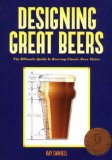

I recently revisited Ray Daniels’ classic work “Designing Great Beers“, a book written in 1996 and published by the Brewers Association. Though I originally read this book several years ago, I enjoyed it even more the second time. For those of you who don’t know this book, it is advertised as “The Ultimate Guide to Brewing Classic Beer Styles” and to a large degree lives up to that billing. Daniel’s book is engaging, packed with useful information and unlike many books has practical advice on how to design recipes for many of the most popular beer styles. Mr Daniels’ book is not for the rank beginner, but is targeted to the intermediate to advanced brewer interested in improving their recipe design. The book is divide into two major sections. The first includes a fairly lengthy introduction to beer design including chapters on major ingredient categories (malt, hops, water, yeast) and the role that each plays in the brewing process. These chapters are also accentuated with explanations on how to estimate key beer characteristics such as original gravity, color, bitterness and water profiles. He also reviews key brewing techniques like mashing and explains their impact on beer design. Each section is extremely detailed, well thought out and packed with information. For example the chapter on color explains not only how to estimate color by how various malts contribute to color during the brewing process. In some areas he dives quite deep into each subject, which is why I would not recommend this book for a beginning brewer. In part 2, Mr Daniels presents detailed chapters on 14 classic beer styles and how to design recipes for these styles. Though part one is good, the chapters in part 2 on beer styles were my favorites. For each style he describes the history of that style of beer, classic ingredients used and brewing techniques associated with the style. In a departure from most brewing books, he presents not a collection of recipes but rather detailed analysis of both commercial and top award winning home-brewed recipes. His analytic approach provides, for example, a profile of the main malt ingredients used for each style and the proportion of those ingredients used. For hops, he has analyzed the number of times each hop variety was used for each popular style giving you a solid guide to which hops are most appropriate for the style. Taken as a whole, his analysis provides a detailed guideline on how to design your target beer style that goes well beyond the typical BJCP style guide. For example, in the chapter on Porters his analysis shows that an average Brown Porter has 55% pale malt, 11% Crystal malt, 4% chocolate and 5% black malt. Roast, Wheat and Munich malts are also sometimes used. Goldings hops were the overwhelming favorite, with Challenger, Fuggles and Northdown also popular. Using the BJCP style guidelines along with Mr Daniels’ templates, it is not difficult at all to create outstanding recipes for any of the styles listed. Styles in part 2 include Barley Wine, German Barley Ales, Bitters, Pale Ales, Bock, California Common, Fruit Beer, Mild Ale, Brown Ale, Old Ale, Pilsner, Porter, Scotch Ales, Stout, Oktoberfest, Vienna and Wheat beer. It is not a stretch to call Ray Daniels’ “Designing Great Beers” book a true classic that belongs on the shelf of any intermediate to advanced brewer. I’ve found it not only an interesting book to read but also a great reference book that I frequently go to when starting a new recipe from scratch. I have to give this book four and a half stars (of five)!
- Designing Great Beers – on Amazon.com


















I found the style chapters in this book to be great, but I really wanted more of them! All the ones in there were so good, I can’t believe he completely left out Belgian beers and American “Hybrid” ales like Ambers and Cream Ales. Perhaps not many homebrewers were doing Belgian stuff in ’96? I’m not sure, but I would really LOVE the type of analysis he does on all these styles to be applied to all types of Belgian beer.
I just bought Mosher’s “radical brewing,” which has some stuff on Belgians, so maybe these two in tandem will be a good combo.
Thanks – I have not purchased Mosher’s book, but I’ll grab a copy soon. I agree that I would love it if Ray published a second book with additional styles.
Pingback: Designing Great Beers: The Ultimate Guide to Brewing Classic Beer Styles | Keg-o-Beer
Pingback: Beer People Revisited « The pALEeocon
Pingback: California Steam | Beer-Geek, Dude. Beer Reviews, beer research, love and save the ales
Pingback: » Brewing an Irish Stout Beer Recipe
Pingback: Leilani – American Brown Ale. Un esempio di come creare la proria ricetta : brewLab
Pingback: Brewing Beer with Honey | Home Brewing Beer Blog by BeerSmith
Pingback: Recipe Writing 101