
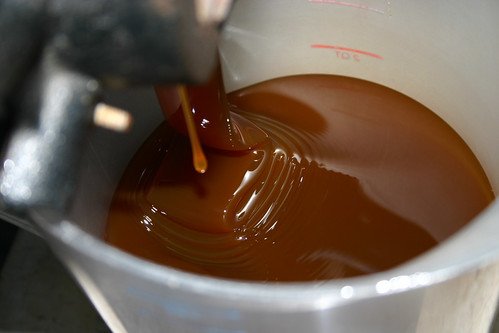
Today we look at a method for malt extract brewers that can improve the quality and color of your extract beer. Both liquid and dried malt extract beers suffer from an effect called a Maillard reaction as well as carmelization when brewing. A Maillard reaction is a chemical reaction that occurs between amino acids and sugars in the wort, and it accentuated by the use of extract in a concentrated boil. Carmelization occurs when liquid extract or excess sugars settle to the bottom of the brew pot during the boil and the sugars carmelize (harden) in the bottom of the pot. Of the two, the Maillard reaction actually accounts for the majority of the color darkening.
This typically darkens the beer, and in extreme cases can also affect the taste of the beer. Obviously this is a problem for brewers of light colored beers. The effect is also common in high gravity beers in small brew pots because of the higher proportion of extract to water when boiling.
To avoid the ill effects of the Maillard reaction and carmelization, malt extract brewers should delay the addition of the majority of their extracts until late in the boiling process. The extract must be added late enough in the boil to avoid darkening, but early enough to assure that the extract is sterilized. Boiling the extract for about 15 minutes is a good balance.
I recommend adding a small amount of malt extract (perhaps 15-25%) early in the boil if using separate hops. The sugars and enzymes in the extract aid in extracting alpha acids (bitterness) from the hops. Boiling hops with a small amount of extract will result in smoother hop flavors and appropriate bitterness that you can’t achieve with plain water alone.
Late extract additions do present one challenge for the brewer. Late extract additions increase the bitterness of the beer. Predicting the International Bitterness Units (IBUs) of late extract additions to match your target style is mathematically complex. Most brewing software and spreadsheets are simply not designed to handle multiple hop and late malt extract additions in the boil. The gravity and bitterness of the boil will vary with each ingredient added.
To do the calculation by hand you would need to calculate the gravity of the boil at each stage, bitterness contribution from each hop addition taking this gravity into account and then combine these into one overall IBU number for the brew. To compensate, some brewers use a “rule of thumb” such as “reduce hops by 20% when using late extract brews”. Another method is to calculate the hops addition without the late extract and then add 5-10% more hops to compensate for lower utilization during the last 15 minutes of the boil.
Recently we did add a late extract option to BeerSmith. To use the late extract option, simply check the “late extract” box when adding extracts to your recipe and specify the boil time. BeerSmith will include all of your hop additions and late extract additions into the IBU (bitterness) calculations, combining them appropriately to predict your overall bitterness (IBUs).
Related Articles


I made a partial mash with late addition extract last night. I’ll be happy to report in the future, but I don’t see the additional bitterness as problem, but a helper really. Granted you have to plan for it, but in a time when hops are more scarce, it’s a positive. 🙂
Pingback: Late Malt Extract Addition » Authority Sites Directory Blog
I have been steeping my grains and adding about 25% of my extract at the start of the boil just to help with the extraction of the alpha acids from the hops. Then adding the rest of the Malt and Adjuncts at the end of the boil with 5-10 minutes left. I have noticed a difference in taste and color. The recent IPA I made was very light in color.
Pingback: Late Extract Additions - Home Brew Forums
Pingback: LME Question - Home Brew Forums
Pingback: boil? - Home Brew Forums
Pingback: True Brew All Malt Amber - Page 3 - Home Brew Forums
Pingback: Adding Malt Extract Late in the Boil | North Carolina Home Brewing
Pingback: Stuck Fermentation @ 1.020 - Home Brew Forums
Pingback: 60 min. full boil Malt Extract vs. late addition Malt Extract - What Say You? - Home Brew Forums
Hello, Nice work! This is very much helpful for my research and i hope to run through more of your posts someday! How i wish i can see you in person so i can get to know you more.
I typically do late extract additions and have been thinking about how they relate to other, darker beer styles. The Maillard reaction might be considered a good thing it certain styles where you’re looking for toasty, caramel flavors — for example scotch ale or rauchbier. In these cases, using extract gives us a benefit over all-grain because we CAN ‘double boil’ it (meaning it has been boiled at the manufacturer and again on our stovetop) and potentially create flavors that wouldn’t be obtainable without a 120+ boil. What do you think, Brad?
Is it necessary to even boil all the extract? Kit brewers have been adding pre-hopped extract directly into the fermenter, often along with liquid or dried malt extract, with no boil at all. Would extract necessarily need to be sterilized?
I think that sterilizing extract is prudent. When I see the big vat it comes out of at the LHBS, I’m not exactly reassured of its sterility.
Pingback: Beginner extract brewing howto - Page 14 - Home Brew Forums
Pingback: Late extract additions? - Home Brew Forums
Pingback: Honey Hefey - Home Brew Forums
I recently started brewing about 4 months ago and just finished my 6th batch. I first read about this late extract addition technique from John Palmer’s ‘How to Brew’ book. I can say without doubt that it has improved the quality of my brews significantly. I’d been brewing high gravity beers (1.065-1.075 IPAs, etc) in a 4 gal pot and the first 4 batches all ended up way darker than expected and with an overly ‘bitter/toasty’ flavor that I didn’t care for. They were much more like heavy brown ales, than IPAs Since I started doing 40%/60% on the extract addition, my last two have come out significantly better. I see no more wort scorching, better hop flavor, no more toasty flavor, and lighter color. I’m not sure why beginner recipes say to add all the extract at the start of boil. From my experience this can do more harm than good to the finished beer.
I’ve tried two late malt addition (last 20 minutes of boil) bs a few months apart from one another and I find that I loose effeciency in my total S.G. and F.G.
Not sure why this is the case but it has held true for both brews. Any idea why?
Brad,
I’m hoping you could help me with something. I’ve been using BeerSmith for a few years now for all-grain brewing. Do to a recent move and space constraints, I’ve had to switch to partial mashes without full boils. I’m now missing my predicted OG by 10+ points. Can you provide any help? The most recent recipe had 5.5 lbs of grain and 3 lbs of dry extract. After top up water, I had a OG around 1.040 (projected near 1.054). I’m adding extract with 15 minutes left.
Thanks.
I would guess you are getting much lower efficiency with partial mashing. Some things to check include your sparging techniques, actual water volumes for your setup and also the quality of your crush. Of the three, I would guess that you may have some volume errors in your setup which could also throw the numbers off.
Well, I might be on a dark side, but a couple of times I have tried following: If the extract came from a new can (freshly opened), I have sterilized the top of the can and then poured it directly info fermenter. I assumed that canning is a process that includes sterilization as well. When the exctract was opened, I boiled it as I cannot guarantee sterile storage. So in the end I have boiled just water with a bit of extract. on the calculator over here http://www.brewersfriend.com/ibu-calculator/ you can put assumed OG of worth – so lower number there should represent not boiling all the xtract with the hops.
So far my results: no contamination, rather good beer. But the beer is rather hazy and several times it had a sort of ‘extracty’ sweet aftertaste. But still ok when all you have is a small pot.
Nice blog. The way of providng the information is too good. I really appreciate your work. keep on.
Still believe you should switch to all-grain brewery. LME or DME are good but really limit you with experiments and recipes, IMHO